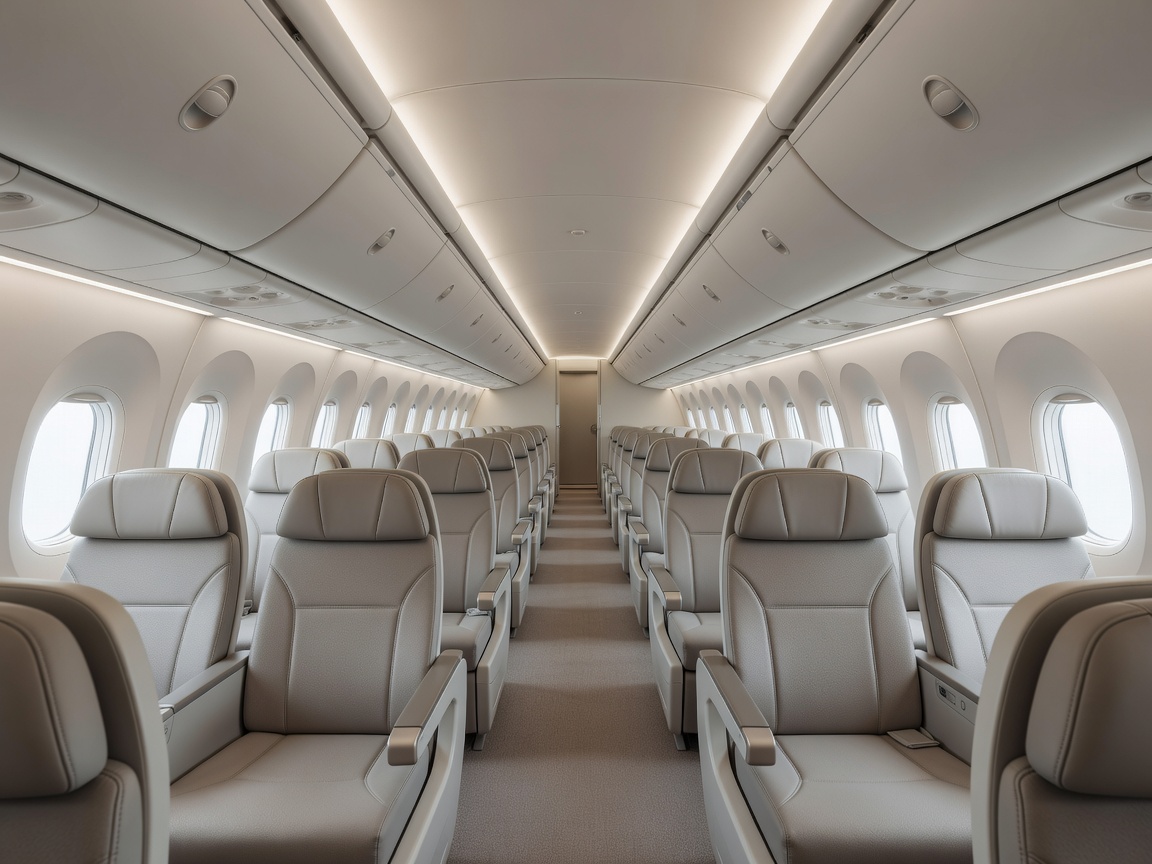
The Wide-Body Advantage
For the traveling public, the Boeing 777 is recognizable by its expansive interior volume. With a maximum interior cabin width of 5.87 meters (19 feet 3 inches), the 777 offers one of the most spacious cabins of any twin-engine commercial airliner ever produced. This immense width fundamentally changes the spatial perception within the cabin, offering higher ceilings, larger galleys, and significantly broader aisles compared to narrow-body aircraft.
The design of the cabin was heavily influenced by airline feedback during the "Working Together" phase, focusing heavily on flexibility and passenger comfort on ultra-long-haul journeys that can easily exceed 14 hours.
The Boeing Signature Interior
Introduced on the 777 and later adapted for other aircraft like the 767 and 747-400ER, the Boeing Signature Interior represents a landmark in industrial design for aerospace. The design moved away from the boxy, squared-off aesthetics of earlier decades, replacing them with sweeping, curved overhead bins and indirect ceiling lighting.
The overhead bins were designed to drop down for loading, meaning that when closed, they integrate smoothly into the ceiling contour. This created significantly more headroom for passengers moving through the aisles. Additionally, the side-wall panels were sculpted to maximize window size and natural light ingress, making the large cabin feel even more airy.
Cabin Configurations: 3-3-3 vs 3-4-3
Because the 777 is primarily utilized by varying global airlines, interior seating arrangements differ significantly. In its original design specification for Economy Class, Boeing optimized the cabin for a 9-abreast seating layout, typically in a 3-3-3 configuration (or 2-5-2 for certain US carriers). This configuration allows for relatively generous seat widths of approximately 18 to 18.5 inches, offering excellent comfort for long-haul sectors.
However, as airline economics grew more demanding in the 2010s, many operators transitioned to a higher-density 10-abreast layout in a 3-4-3 configuration. While this increases total passenger capacity and revenue per flight, it generally narrows the individual economy seat width to around 17 inches and reduces aisle width. Premium cabins (Business and First Class) have simultaneously seen remarkable upgrades on the 777 platform, with many airlines installing elaborate enclosed suites, direct-aisle-access lie-flat beds, and onboard bars, utilizing the wide cabin cross-section to maximum effect.
Acoustics and Ride Quality
Given the immense size and power of the engines—particularly the GE90—one might assume the 777 cabin is exceptionally loud. However, Boeing employed extensive acoustic insulation in the fuselage sidewalls and under the floorboards to mitigate engine hum and aerodynamic noise. The result is a relatively quiet cruise experience, especially forward of the wing in the premium sections.
The sheer size and mass of the 777 also contribute to excellent ride quality. Heavy aircraft possess greater inertia, meaning they are less susceptible to the sharp jolts of minor atmospheric turbulence compared to smaller, lighter jets. The advanced fly-by-wire system also plays a subtle role, making microscopic, automatic adjustments to the control surfaces to dampen yaw and pitch oscillations during turbulent air encounters.
The Future: 777X Innovations
Looking ahead, the upcoming 777X series intends to further elevate the passenger experience. Borrowing heavily from the 787 Dreamliner, the 777X will feature larger, dimmable windows and a lower cabin altitude pressurization. Traditional airliners are pressurized to simulate an altitude of about 8,000 feet, but the 777X will lower this to approximately 6,000 feet. This higher pressure, combined with advanced cabin humidification systems, is designed to reduce travel fatigue, jet lag, and dry eyes, ensuring that the 777 lineage remains at the forefront of passenger comfort well into the century.